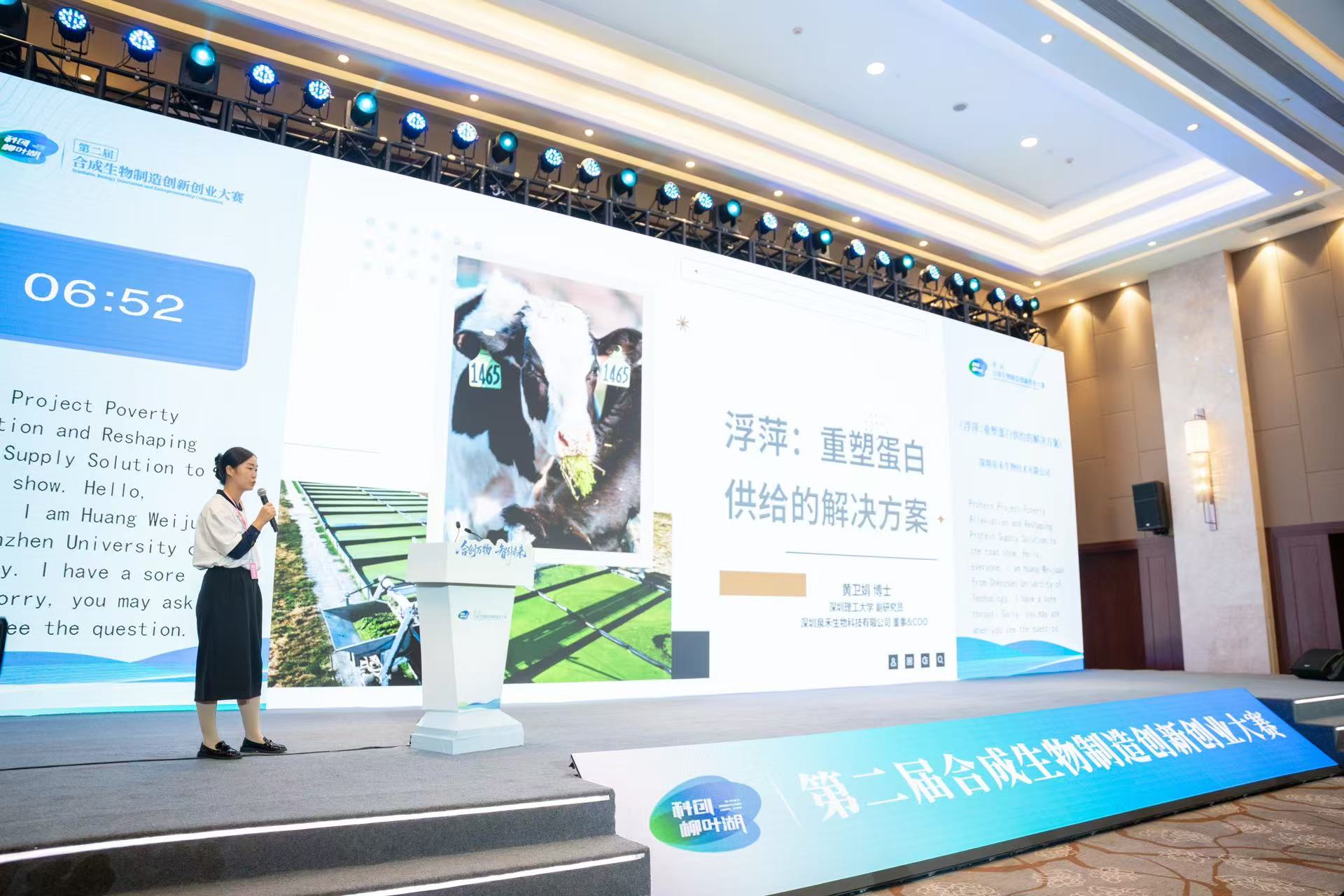
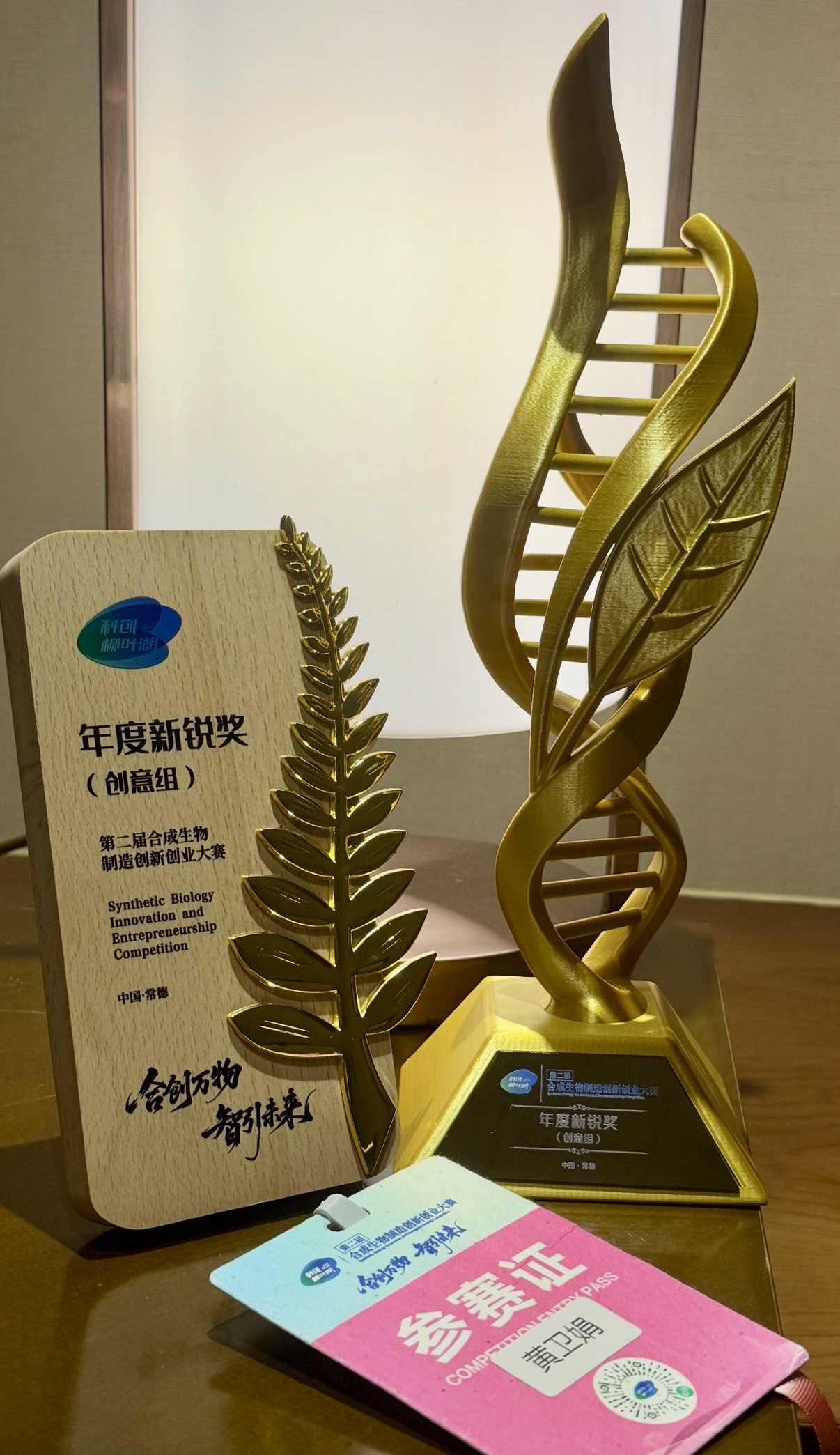
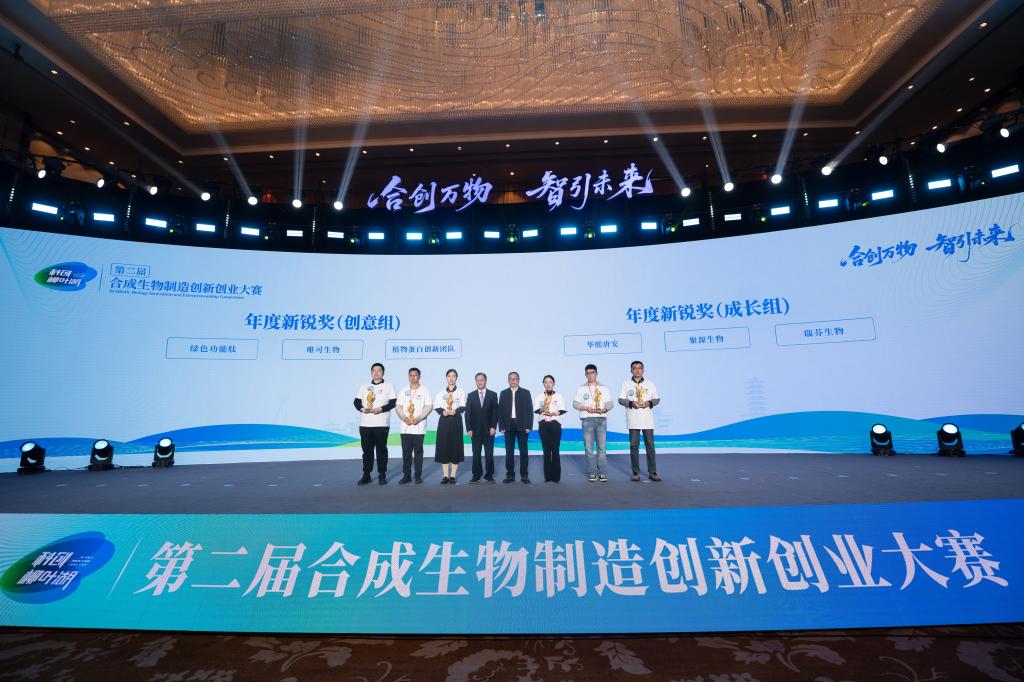
Recently, the award ceremony of the 2nd “Science and Innovation - Liuye Lake” Synthetic Biology Innovation and Entrepreneurship Competition was held in Changde, Hunan Province. Associate Research Professor Huang Weijuan from theInstitute of Emerging Agricultural TechnologyofShenzhen University of Advanced Technology participated on behalf of the duckweed R&D team with the project “Duckweed: A Solution to Reshape Protein Supply.” With its cutting-edge technological concept and broad application prospects, the project stood out from 338 high-quality entries and won the “Annual Emerging Award” in the Creative Group category.
The competition was guided by the National Industrial Innovation Center for Bio-manufacturing and the Tsinghua University Center for Synthetic and Systems Biology, and was co-organized by the Department of Science and Technology, the Department of Industry and Information Technology, the Department of Education of Hunan Province, and the People’s Government of Changde City. The competition pioneered a dual-track system of “Growth Group” and “Creative Group,” covering the full chain from laboratory inspiration to market industrialization. It attracted top domestic tech-innovation enterprises, young entrepreneur teams, investment and financing institutions, and industry leaders, and has become a benchmark event in the field of synthetic biology.
The duckweed protein project presented in the roadshow is an important achievement of theInstitute of Emerging Agricultural TechnologyofSUATin the development of novel non-grain proteins. The project is led by Professor Yang Zhenbiao, a world-renowned botanist, foreign member of the European Molecular Biology Organization (EMBO),directorof theInstitute of Emerging Agricultural Technologyand Vice Dean of the School of Synthetic Biology atSUAT. Based on these technological achievements, Shenzhen Quanhe Biotechnology Co., Ltd. was established in Shenzhen’s Guangming District to further promote industrialization. At present, the project has built a pilot-scale line with an annual output of several tons of feed protein, is constructing a 100-ton pilot-scale line for feed protein, and plans to build a 10-ton pilot-scale line for food protein.
Based on synthetic biology, the project is committed to building the world’s first non-grain plant protein biomanufacturing platform, with three core technical systems: a high-throughput phenotyping and breeding platform, an AI-empowered plant codon optimization platform, and a high-value protein biomanufacturing platform. It develops three product lines: feed-grade, food-grade and medical-grade, providing a brand-new solution to China’s import dependence on protein raw materials and the constraints of arable land resources.
At present, China’s soybean imports exceed 100 million tons annually, and the feed industry’s external dependence on protein raw materials remains high. There is an urgent need for non-arable, low-cost, and high-protein alternative proteins to break the development bottleneck. As a “green super protein,” duckweed not only has a protein content comparable to egg white protein, but also has outstanding advantages such as no arable land occupation, fast growth and low labor cost, making it an ideal new protein source.
The team has developed a new high-protein, high-lysine duckweed line DW2408 (44% protein content), which performed excellently in feeding trials on tilapia, geese, and other animals. After replacing part of the traditional feed with duckweed protein, key indicators such as weight gain rate and digestive enzyme activity were significantly better than those of the control group.Now, the project has established cooperation with a number of leading breeding enterprises, including Nansha Agriculture Corporation and FujianTianmaScienceAND TechnologyGroupCo., Ltd., and is steadily advancing duckweed protein from laboratory achievements to industrial application.
This award is not only a high recognition of the research strength and industrial transformation potential of the duckweed R&D team, but also an affirmation of the Institute’s forward-looking layout in empowering agricultural innovation with synthetic biology.
In the future, the duckweed R&D team will continue to focus on duckweed protein and new alternative proteins, accelerate pilot scale-up and market transformation, and provide solid support for China’s food security and the upgrading of the biomanufacturing industry.
Source: Official WeChat Account of the People’s Government of Changde
Editor: Xiaolei Sun
Reviewer: Weijuan Huang




 News
News