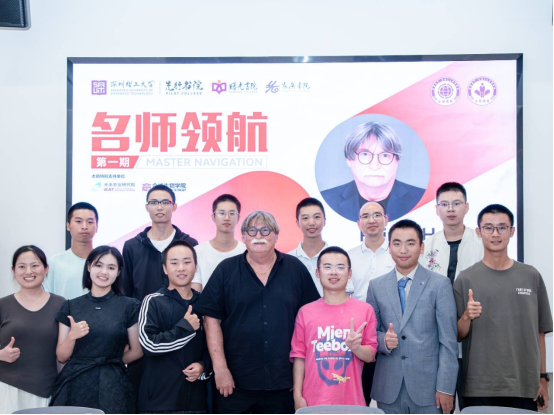
Rainer Hedrich, Chair Professor at Shenzhen University of Advanced Technology (SUAT) and a Member of the German National Academy of Sciences, recently captivated students during a lecture and subsequent in-depth discussions, challenging their preconceptions about leading academics.
He officially joined SUAT in January 2025 as Chair Professor at the School of Synthetic Biology and Director of a research center at the Institute of Emerging Agricultural Technology. Renowned for his pioneering scientific contributions, Prof. Hedrich left a strong impression on students. Students such as Xie Yifei had initially expected an imposing figure but instead found him remarkably approachable, describing him as “like a kind elder.”
A High-Level Lecture: Demystifying Plant Ion Channels
On September 17, Prof. Hedrich delivered an academic lecture titled “History and State-of-the-Art of Plant Ion Transport and Signaling” to nearly 100 undergraduate students at SUAT. The event was hosted by Professor Yang Zhenbiao, Dean of the Institute of Emerging Agricultural Technology.
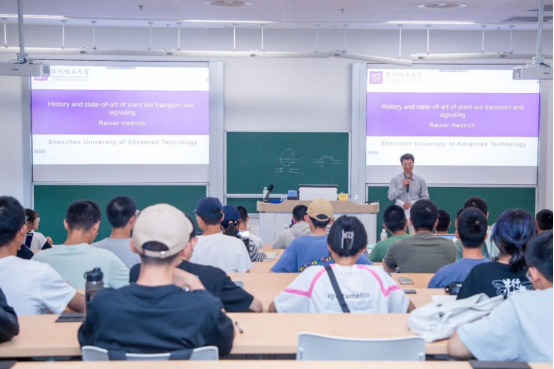
In his engaging presentation, Prof. Hedrich traced the historical development of the field, from Darwin’s early observations to modern scientific breakthroughs. He highlighted a pioneering question he posed in 1983: “Do plants have ion channels?” He further explained that, although plants lack nerves and muscles, they possess highly sophisticated ion channel systems that enable them to perceive environmental cues and adapt to changing conditions.
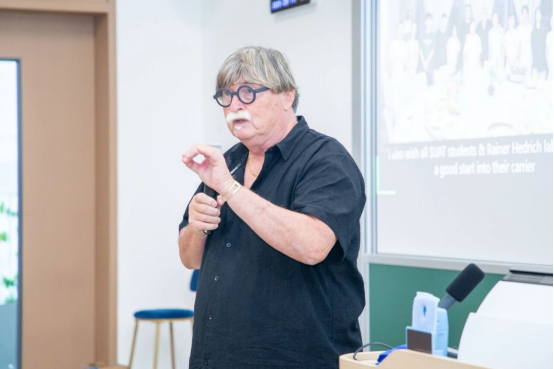
Prof. Hedrich vividly illustrated how plants perceive a range of environmental stimuli, including visual, tactile, olfactory, and taste-related cues, and how they utilize physical energy forms such as light, pressure, and electrical signals for intercellular communication. Using the Venus flytrap as a compelling example, he explained how its trigger hairs function as highly sensitive mechanical sensors, generating action potentials that enable the rapid capture of prey.
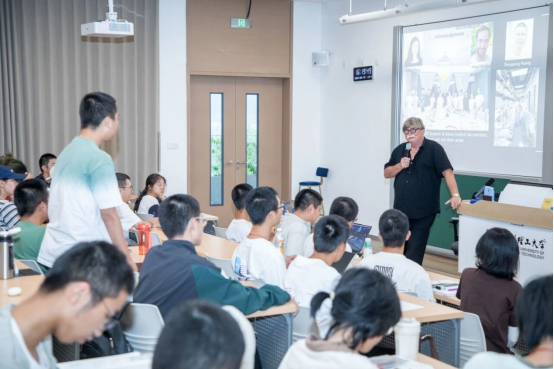
Despite his extensive publication record in leading journals such as Nature and Science, Prof. Hedrich explained complex electrophysiological concepts in clear and accessible language, earning enthusiastic applause from the audience.
Face-to-Face Dinner: Merging Science Insights with Life Guidance
Following the lecture, Prof. Hedrich participated in a “Mentor Navigation” dinner with nine freshmen, together with Prof. Wang Xin from the Faculty of Synthetic Biology and Prof. Ye Lingling from the Institute of Emerging Agricultural Technology. The event was organized by the Pilot College, which is currently under preparation.
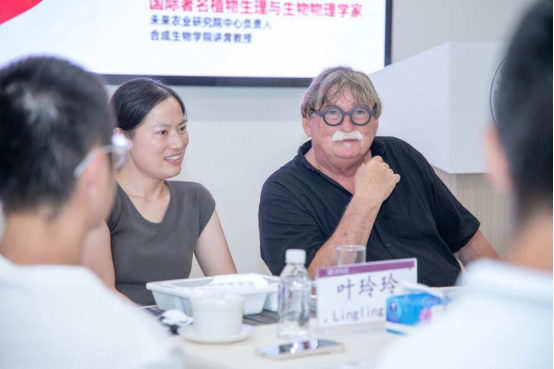
Conversations flowed freely across a range of topics, including plant drought-response mechanisms, the application of artificial intelligence in biology, and the future of agriculture. When asked about improving the medicinal value of traditional Chenpi (citrus peel), Prof. Hedrich emphasized a research-driven strategy: first identifying active compounds through cell culture experiments, and then optimizing them using metabolic engineering or fermentation technologies.
In discussing AI and gene editing, he highlighted their current applications in developing pest-resistant, high-yield crops, as well as in smart agriculture systems involving robotics and nutrient monitoring. He further encouraged students to acquire strong competencies in computer science and artificial intelligence to better align with the evolving demands of modern scientific research.
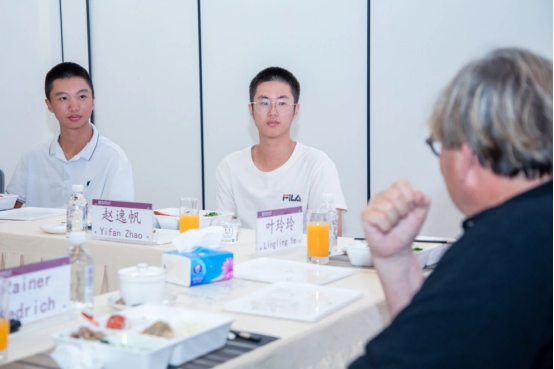
Sharing his personal journey, Prof. Hedrich encouraged students to maintain curiosity, explore interdisciplinary fields, identify their passions, and cultivate sustained, critical thinking habits. He also commended SUAT’s first-year research rotation system, which enables students to experience different laboratories and industrial settings before declaring their majors.
Student Impressions: Inspiration and Fresh Perspectives
Chen Chen, Class of 2025:"Although the lecture was delivered in English, Professor Hedrich's vivid explanations, combined with my plant physiology background, enabled me to follow along seamlessly. From patch-clamp principles to the Venus flytrap's unique mechanisms, he guided us to appreciate the wonders of natural science."
Li Shoubin, Class of 2025:"I never deeply pondered how a nerve-less plant could catch insects. Prof.Hedrich explained that the Venus flytrap's trigger hairs must sense a specific force threshold to generate an 'electrical signal' or action potential. This mechanism is highly inspiring—it could even inform new principles for robotics and environmental sensing technologies."
Wang Jiuqi, Class of 2025:"I previously imagined top academics as overly serious figures. Meeting Prof.Hedrich showed me that an academician can be both humorous and down-to-earth. When he said, 'I was born for science,' I felt his genuine passion. His advice to find and persist in one's passion has provided greater clarity for my academic journey ahead."




 News
News